Energistics® Publishes
the Practical Well Log Standard v4.0
The Practical Well Log Standard (PWLS) is an important tool that makes it easier to query oilfield data—such as well log data, which is crucial data that is captured, stored, managed, and used during the lifecycle of an asset, often for many decades. For users of such data, PWLS improves data discoverability and interoperability across organizations and datasets, which contributes significantly to project efficiency, improved accuracy, and more reliable results.
PWLS is already used in implementations of both Energistics standards and the OSDU® Data Platform. This new release expands the standard, improves interoperability, and empowers the industry through new delivery options and update capabilities.
San Francisco, CA, June 26, 2026 – The Energistics Consortium, an affiliate organization of The Open Group®, has published the Practical Well Log Standard (PWLS) version 4.0. You can download it from the Energistics page in The Open Group Standards Library here.
While PWLS originally focused on well log data, v4.0 extends its applicability to a broader range of subsurface data, including seismic attributes and interpreted properties. This evolution enables PWLS to serve as a common cross-domain classification framework across wells, geophysics, and reservoir workflows.
“A standardized catalog of property kinds and units of measure is fundamental to achieving true interoperability across the subsurface ecosystem,” explained Abhi Goswami, PWLS Work Group Member, OSDU Forum Geophysics Data Definitions Co-lead and Principal Consultant, Integrated Data Landscape and Data, Digital & Innovation, Shell. “By anchoring on a single, authoritative source like PWLS, the OSDU Data Platform enables vendors and operators to avoid fragmented reference data and ensures consistency across applications. Just as important, this work reflects the power of collaboration between the OSDU Forum and Energistics in addressing a long-standing industry challenge in a scalable and unified way.”
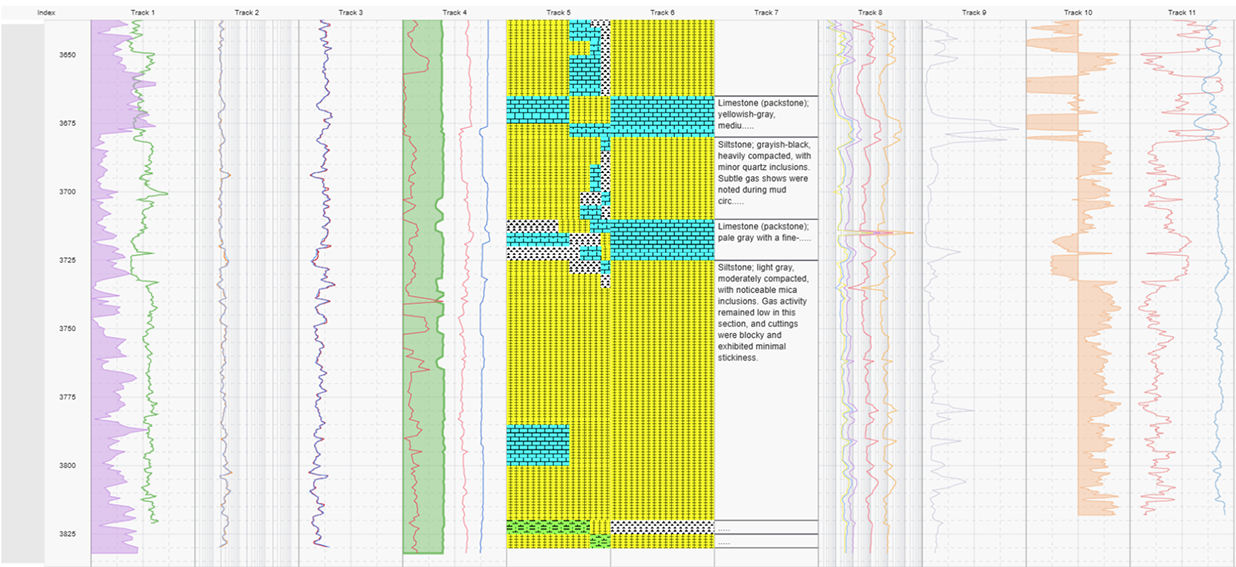
Well Correlation Panel - Courtesy of Bardasz
The Problem PWLS Helps Solve
The main goal of PWLS is to support the classification of oilfield data. A significant amount of this data is well log property measurement data—usually referred to as curves or channels or logs—that are commonly used by energy companies, and to use this classification as a tool to enable general queries over large data repositories. For energy companies, log data is a crucial asset used to inform both current and future development and operational decisions, throughout the lifecycle of the asset. In general, all log data for all wells are stored, managed, and used for perpetuity.
To get an idea of the volume of log data, think about the number of oil and gas fields in the world (about 25,000 in total of which 1,500 are major fields1), the number of wells in each field (which range from a handful to many thousands, depending on the field), and that each well may have hundreds of measurements (or individual logs). Energy companies, service companies, and government bodies all store and use historical and current well log data. To find the relevant well log data needed for a given project, people must search through vast volumes.
To further complicate the challenge, service companies that collect this data shorten log names to 3-, 4- or sometimes 5-character codes—commonly referred to as mnemonics—which are not sufficiently descriptive of the measurements taken or of the nature of the tools in use. In practice, a property named “hook load” might be “HLD” from one logging company and “HKLD” from another logging company or other forms, making it difficult for end users to find all “hook load” data.
When we consider the well log data volumes with the lack of standard mnemonics across different companies, then the magnitude of the problem becomes clear.

How PWLS Works
PWLS provides an industry-agreed, hierarchical list of standardized property names; logging companies can then map their mnemonics to a specific standardized property name. If a system or server implements PWLS, then that system allows oil and gas professionals to perform queries such as “give me all the hook load logs,” (where “hook load” is the PWLS property name), and the system can return all relevant logs, regardless of the variety of mnemonics used.
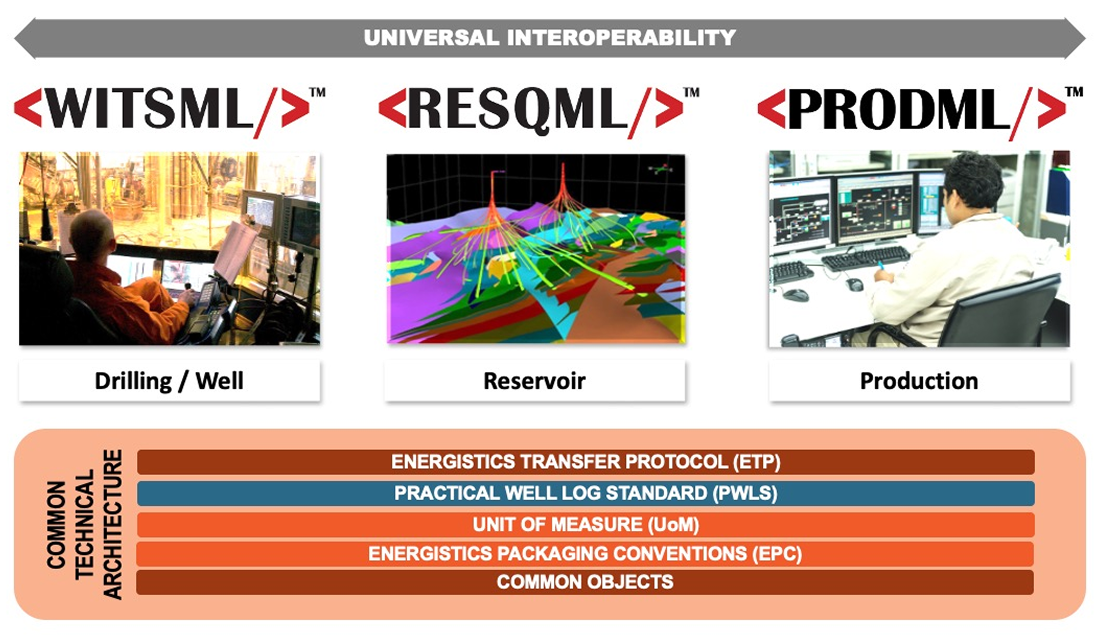
The property names—which PWLS calls Property Kinds—are also mapped to a relevant quantity class. A quantity class describes the physical dimension of a property, such as length or pressure, which helps to apply compatible units of measure (from the Energistics Unit of Measure Standard) to a property without mandating specific units for each property, which would be arduous to document and impossible to maintain.
Updates for PWLS v4.0
In PWLS v4.0, the PWLS Work Group, composed of members from both Energistics and the OSDU Forum, added more than 250 new Property Kinds to support plug‑and‑perf fracturing data and 11 new seismic data types. Additionally, corrections were made to existing data types.
Starting with this version, the distribution format of PWLS has also changed. Previous versions were delivered only as Excel spreadsheets. The content of PWLS was moved to a GitLab® repository and continuous integration (CI) pipelines were developed, which improve validation checking and allow the same content to be produced in multiple formats, with a goal of improving the adoption and distribution of PWLS. Now PWLS is distributed with these files (each with the same content):
- PropertyKindDictionary XML (in EML v2.3 format) file (PWLS_PropertyKindDictionary_v4.0_eml23.xml) containing all the Property Kinds. This format is for the latest versions of the Energistics domain standards: WITSML v2.1, RESQML v2.2, and PRODML v2.3.
- Property Kinds Excel file (PWLS_PropertyKind_Dictionary_v4.0.xlsx) containing all the Property Kinds in a more human-readable and filterable format.
- EML v2.3 Energistics Packaging Convention (EPC) file (eml23_pwls40.epc) containing all the Property Kinds. These are also compatible with the latest version of the Energistics domain standards.
- a RESQML v2.0.1 Energistics Packaging Convention (EPC) file (resqml201_pwls40.epc) containing all the Property Kinds.
PWLS is complemented by the new PWLS Curve Catalog2—an industry-supported public repository of logging company mnemonics mapped to PWLS Property Kinds.
While the mapping of company-specific mnemonics to standard property kind names is the crucial benefit of PWLS, that mapping is not “the standard.” The standard is the industry-agreed property kind names. This fact, coupled with the fact that logging companies are constantly adding new tools and new mnemonics, made it clear to the PWLS Work Group that this company-specific information could be hosted for self-serve updating. This approach was vetted with the Energistics members, the Energistics Business Work Group, and the Energistics Board of Directors.
“Through community collaboration, Energistics recognized that mappings between company-specific logging mnemonics and PWLS Property Kinds are best owned and maintained by the service companies that generate the data,” said Craig Bye, PWLS Work Group lead, Energistics Board Director, and VP of Cloud Platform and Applications at Pason Systems. “By separating those mappings from the PWLS standard, we’ve enabled a self-managed, self-service model where updates can happen as soon as they’re needed. This gives service companies direct control over their data, provides operators with faster access to the most current information, and allows the PWLS standard itself to evolve on a more streamlined and predictable release cycle.”
References
- Wikipedia (accessed April 24, 2026). List of Oil Fields. https://en.wikipedia.org/wiki/List_of_oil_fields
- PWLS Curve Catalog. https://curves.energistics.org/